Prep School Basketball Recruiting: What Every Athlete and Family Needs to Know
In today’s prep basketball landscape, players and families are often faced with a critical decision: reclassify for an extra year of high school or take a post-grad year after graduation. This choice can significantly impact player development, recruiting exposure, and academic readiness.
We touched on this topic in our recent interview with Max Gordon, Head Coach at St. Paul’s School. Max brings first-hand experience as a player who reclassified and now leads one of the top academic prep programs in the country. His perspective gives student-athletes, parents, and coaches a clear look into how to evaluate this important decision.
Reclass vs. Post-Grad: Why the Extra Year Matters
Cory: Now, let me walk back to a statement you said when you chose Exeter. You chose to reclass. And I was just talking to a family yesterday about reclassing versus staying the course and then doing a post-grad year. Explain your logic on this—benefit one over the other?
Max: For me, that opportunity to have two years at a place—two years with a coach, teammates, from an academic perspective—was huge. Every player that does this boarding school process, whether it’s two, three, or four years, they all realize how much easier that second year is than the first.
Cory: Absolutely.
Max: The adjustment year is big—level of play, academic rigor, just being away from home. And then, all of a sudden, second year hits and you’re like, “I’ve got this.” Everything gets better—on the court, in the classroom, your relationships. That second year experience is what I was looking for, instead of just a one-and-done.

Pre-game unity: St. Paul’s players lock in and motivate each other before the action starts.
Understanding the Benefits of a Two-Year Experience
Max: At St. Paul’s, we don’t do post-grads. That two-year experience is transformative. Our guys feel like true graduates. They want to come back, they’re in touch, they’ve built something here. That’s harder to do with a single-year experience, which can sometimes feel a little more transactional.
When Post-Grad Might Be the Right Fit
Cory: Am I assuming Exeter wouldn’t have done a 12th-grade post-grad option for you?
Max: I think they would have if I’d wanted it. But personally, I needed that extra year to develop physically, build confidence, get reps and playing time. And I needed that year academically too. It was just so valuable.
Max: We get questions all the time from families—”I’m a great student, why should I reclass?” Players usually get it right away. Parents, especially outside of New England, often need to be introduced to the concept.
Max: That independence, academic rigor, and physical development—the extra year makes a real difference in becoming college ready.
So… Is One Option Better?
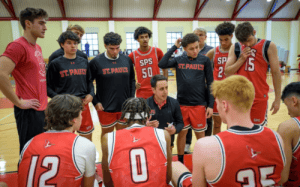
Coach Max Gordon breaks down a play during a timeout with the St. Paul’s varsity team.
Cory: So if a player has two years either way—reclassing 11th/12th or doing a 12th-grade post-grad—does it matter?
Max: That’s a good question. It’s tricky. There are NCAA rules and eligibility windows to think about. And a lot depends on what the family is looking for and what the school offers.
Cory: There’s something with being able to retake classes as a post-grad, right?
Max: Yeah. As a post-grad, you can retake a class or two—especially if you have an IEP or learning disability. But at high-academic schools like Exeter or St. Paul’s, most of the time, kids don’t need to retake anything. The course offerings are robust enough that they can stay challenged without repeating.

Elevation and execution—St. Paul’s #50 powers a dunk home mid-game.
Flexibility and Fit: It’s Not One-Size-Fits-All
Max: I’ve seen players do a post-grad at a place like Bridgton—they want to wait and see what recruiting looks like after senior year. That kind of flexibility can make sense for the right player.
Max: But for me, I didn’t want that uncertainty—do I apply again to my current school, what happens next? I wanted two years where I could invest fully in one place. That was the difference maker.
Cory: What I tell families: Talk to each school’s coach. Some schools might prefer one path over the other. And in today’s game, which is getting older, most kids need that fifth year regardless. Just figure out which format fits best.
Final Take: It’s About Long-Term Growth
Max: Ultimately, it’s individual-based and school-based. Know what you’re looking for, talk to the coach, and choose the path that aligns with your goals—developmentally, academically, and athletically.

Player #35 elevates for a powerful dunk during live gameplay at St. Paul’s.
Your Next Step: Ask the Right Questions and Choose with Clarity
Whether you reclassify or take a post-grad year, what matters most is the fit—academically, athletically, and personally. Max’s story is a great reminder that this isn’t about checking a box. It’s about choosing the path that will truly help you succeed at the next level.
If you’re looking into prep school, reach out to us at PREP Athletics. We’re here to help you explore your potential and make choices that align with your athletic and academic future. We’ve also got a long list of resources to get you started in the right direction, so check out our latest prep basketball updates on YouTube or our podcast to dive deeper.