Prep School Basketball Recruiting: What Families Need To Understand About Playing Time and Development
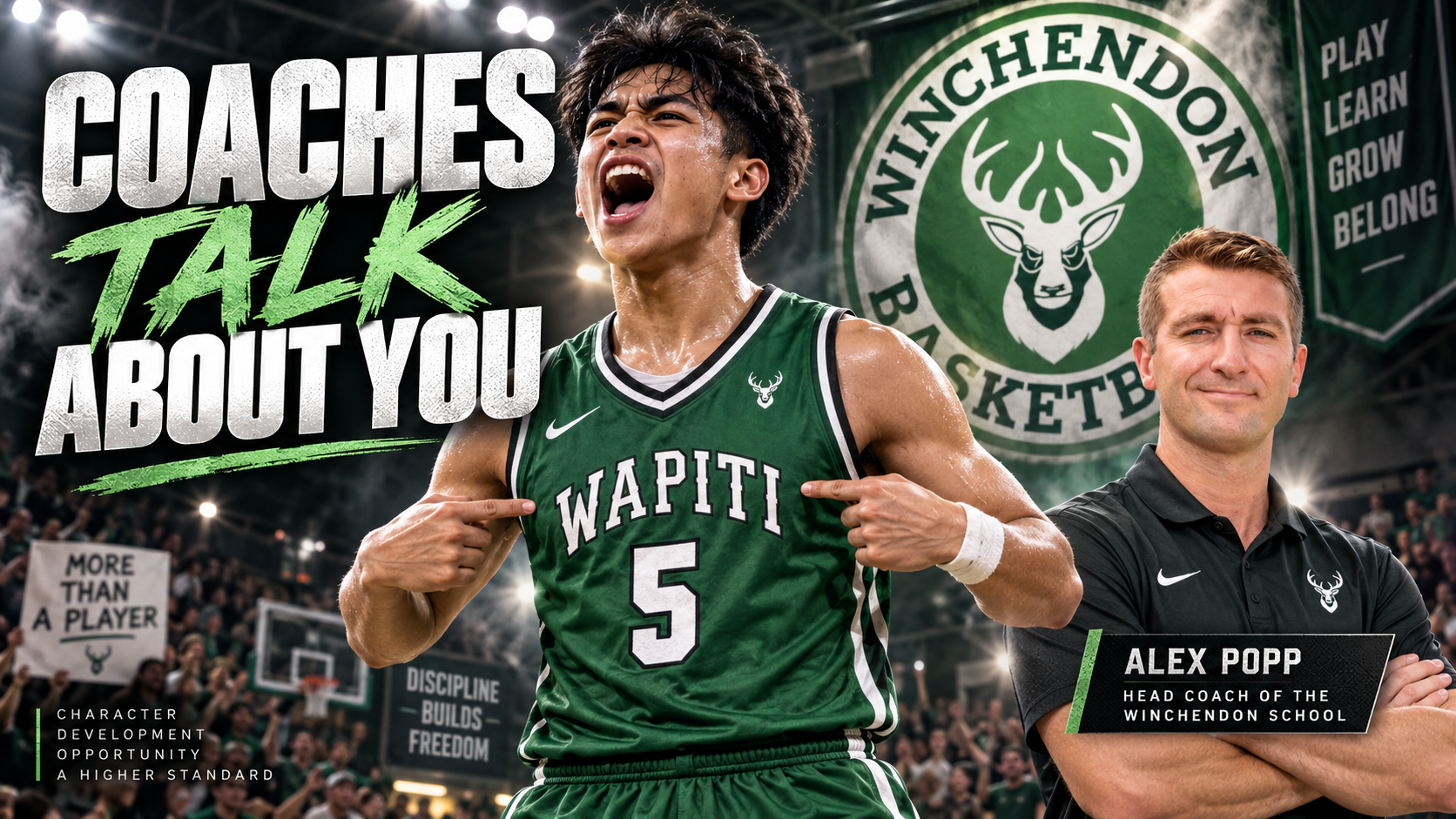
One of the biggest mistakes families make is looking at playing time in isolation. Development is not just about minutes. It is about culture, competition, and performing under pressure. We touched on this topic when we sat down with Coach Alex Popp of Winchendon School, one of the most respected voices in prep basketball. His insight is invaluable for any family weighing the choice between being the man on a weaker roster or earning a role on a strong, culture driven team.

The Winchendon School coaching staff continues to set the standard with leadership, development, and a culture built for athletes who want to grow on and off the court.
Game Reps vs Practice Reps: Why Minutes Matter More Than Most People Think
Pressure, Bright Lights, and Real Development
Cory: There are teams where kids get a lot of playing time, but the talent is not as good. And there are teams with a lot of talent, but you might not get as much playing time. Philosophically, which is more ideal for a kid?
Alex Popp: “Truthfully, experience is the best teacher. And I have seen guys do redshirt years. And I think practice is just not even close to what games are like, even if you are in the most competitive environments. Time score, the bright lights, the way the game’s officiated, the execution of the strategy. I firmly believe that playing time is the premium.”
Games expose players to:
- Real consequences
- Real fatigue
- Real decision making
- Real defensive pressure
You cannot simulate this fully in practice, even in elite environments.
Culture, Winning, and the Value of Being a Rotation Player

Winchendon players locked in during a team session, breaking down film, strategy, and the habits that build winning basketball.
Alex Popp: “Being a rotation player or even a starter in a program that has great culture and that has a good amount of success, I think that is what athletes and their families should be aiming for if the goal is to maximize progression.”
He continues:
“There are programs both grassroots and AAU and prep school that are so good at college placement that you might have a better chance at that Division One scholarship if you are 11 or 12 on that roster versus two or three or the top guy on another roster.”
This is the data backed truth:
Role players on strong teams often end up with better recruiting outcomes than stars on weak teams.
Why?
- Exposure events attract coaches to loaded rosters
- Winning teams generate more film and more interest
- College coaches trust programs with proven placement history
- Playing in meaningful games builds competitive maturity

Energy off the bench fuels winning basketball — Winchendon players erupt after a momentum-shifting play.
The Long-Term Path: Why Being a Rotation Player Pays Off
Recruiting Reality: Coaches Talk, and Placement Matters
Alex Popp:
“You want to stay long term greedy. Being a rotation player is the best path for getting better. It is also the most fulfilling path.”
He reinforces an overlooked truth:
- College coaches constantly talk with each other
- They trust coaches in programs with strong culture
- They reward players who can contribute to winning
Families often think short term (“more shots, more minutes”), but coaches think long term (“who can help us win games in college”).
The Hidden Advantage: Being Surrounded by Talent

22 assists. Only 6 turnovers. A statement win at Harvard — and a perfect example of team basketball. 🏀
Alex Popp:
“At the end of the day, you are going to have to perform when you get to college regardless. If a program is so good at college placement that it gives you a better chance at Division One, that matters.”
Being pushed every day by future college players:
- Raises your competitive threshold
- Forces higher daily standards
- Makes you adjust to speed, physicality, and pace
- Helps college coaches project your game accurately
Stars of weak teams rarely get that same environment.
Final Thoughts: Choosing the Path That Actually Develops Players
The smartest families choose development over ego. Growth comes from meaningful minutes, real competition, and being coached hard in a culture that values winning. What Coach Popp shares here lines up with what I have seen for years: rotation players on strong teams grow faster, get better opportunities, and are more prepared for college basketball.
If you want help figuring out the right balance for your son or daughter, reach out anytime. I talk with families every day about these exact decisions.
If you’re looking into prep school, reach out to us at PREP Athletics. We’re here to help you explore your potential and make choices that align with your athletic and academic future. We’ve also got a long list of resources to get you started in the right direction, so check out our latest prep basketball updates on YouTube or our podcast to dive deeper.