If you spend enough time around prep school basketball, eventually you realize something important:
The schools that consistently place players at the college level are not just recruiting talent. They’re recruiting fit.
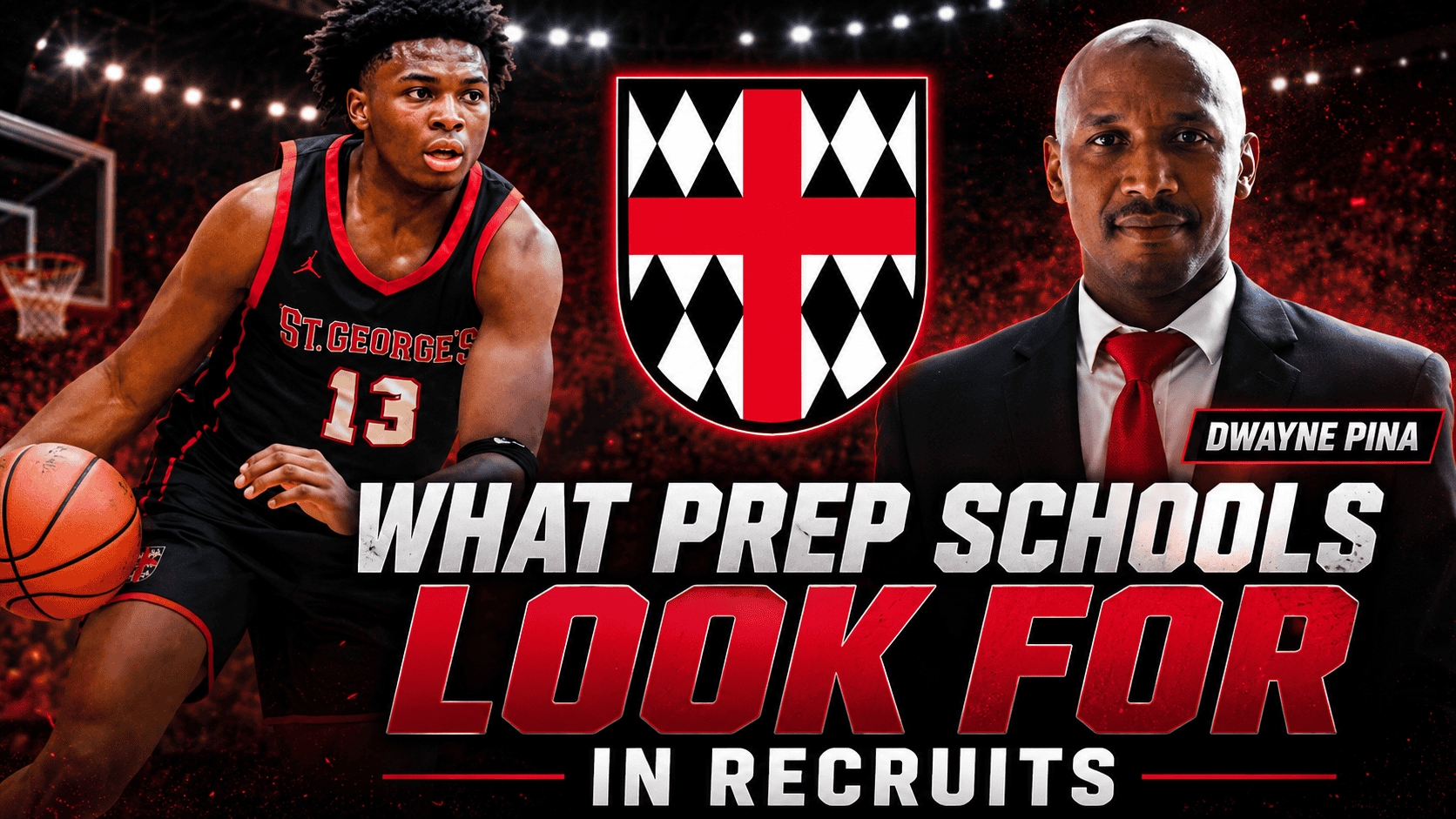
That was one of the biggest takeaways from my recent conversation with St. George’s School head coach Dwayne Pina, who has coached at Bryant, Brown, and now one of New England’s premier prep programs. Pina has coached NBA player Tyler Kolek, helped St. George’s transition into AA prep basketball, and has spent nearly a decade building a program rooted in development, academics, and culture.
And during our conversation, he gave one of the most honest breakdowns I’ve heard about what prep schools are actually looking for in players today.
Not social media hype.
Not mixtapes.
Not rankings.
Real traits that translate.
The Biggest Misunderstanding Families Have About Recruiting
One of the most important things Pina talked about was alignment.
Too many families enter the recruiting process with expectations that don’t match the reality of where college coaches see the player.
As Pina explained:
“If we need to be aligned with what your college expectations are… if I think that you should be in the UAA and you’re thinking ACC, we’re not aligned.”
That disconnect creates problems.
Parents often focus on the logo or the dream level before understanding what the actual recruiting market says about the player. And according to Pina, the earlier families understand realistic fit, the smoother the process becomes.
This is especially important now because the recruiting timeline has shifted dramatically because of the transfer portal.
The Transfer Portal Has Changed Everything
One of the more eye-opening parts of our conversation was how the portal has delayed recruiting opportunities for high school players.
Pina explained that commitments are happening later than they used to, especially for players outside the high-major level.
That means players and families need patience.
The old model of “play well junior year and commit early” is no longer guaranteed. Coaches are filling roster spots with older, experienced transfer players first, which pushes high school recruiting further down the calendar.
That doesn’t mean opportunities disappear. It means development and long-term growth matter even more.
What Prep Schools Actually Want in Recruits
So what are prep schools truly looking for?
According to Pina, it starts with three things:
- Character
- Academic fit
- Basketball upside
And character comes first.
“Very rarely will I recruit a kid that I don’t get to know your parents or your guardian or an adult that’s really close to you… I need to know what cloth you’re cut from.”
That quote says a lot.
Prep schools are not just basketball programs. They are 24-hour communities. Coaches are evaluating whether a player can handle structure, academics, relationships, and independence.
Basketball matters. But fit matters more.
At St. George’s specifically, Pina explained they primarily recruit younger players:
- High-level freshmen
- High-level sophomores
- Occasionally impact juniors
Why?
Because development is the priority.
Why Development Matters More Than Ever
One thing I appreciated about Pina’s approach is how intentional their player development model is.
At St. George’s, development is built into the daily schedule. Players train year-round with:
- Strength and conditioning
- Skill work
- Pickup basketball
- Captain’s practices
- Pool recovery workouts
- Mandatory shooting volume sessions
And because it’s a boarding school environment, players have access to everything in one place.
“One of the benefits of coming to a boarding school like St. George’s is the access to resources – the court, the pool, the weight room, your teachers are all a stone’s throw away.”
That’s one of the biggest advantages prep schools still offer over traditional environments.
More reps.
More structure.
More accountability.
And ultimately, more growth.
The Truth About Ivy League Basketball
Another topic we discussed was Ivy League recruiting, because so many PREP Athletics families ask about it.
Pina coached at Brown University, and he made something very clear:
The level is much higher than most people realize.
“Those schools are playing basketball at a really, really high level… those schools are winning NCAA tournament games.”
That’s an important reality check.
Families often assume “Ivy League” means academics first and athletics second. But modern Ivy League basketball is filled with high-level athletes, NBA prospects, and players who could compete in many power conferences.
The standards are incredibly high.
What Separates Division I Guards Today?
I asked Pina one of my favorite questions:
What does it take to be a Division I guard in today’s game?
His answer was fascinating.
Yes, skill matters.
Yes, feel matters.
But physical tools still separate players.
“There’s a lot of really skilled players that can play Division I, but I think the offers come when you add that other element – that size, that athleticism, that speed.”
That’s a hard truth for many players to hear, but it’s real.
At higher levels, coaches are often betting on physical upside combined with skill.
Pina also made an important distinction:
There’s a difference between being good enough to play Division I basketball and actually receiving Division I offers.
Those are not always the same thing.
Why Tyler Kolek Became an NBA Player
One of the coolest parts of our conversation was hearing Pina talk about former St. George’s standout Tyler Kolek.
What stood out wasn’t athleticism.
It was mentality.
“It’s his mentality and it’s his work ethic… and then it’s his IQ and feel and understanding of the game.”
Pina even compared Kolek’s basketball feel to LeBron James’ ability to process the game mentally.
That’s incredibly high praise.
And it reinforces something important for younger players:
Basketball IQ still matters. A lot.
Prep School Basketball Isn’t Going Anywhere
As the landscape changes with academies, NIL, and the transfer portal, many people wonder what the future of prep school basketball looks like.
Pina believes schools with real history and strong institutional foundations will continue to thrive.
And honestly, I agree.
The best prep schools still offer something unique:
- Community
- Structure
- Development
- Academic support
- Access
- Exposure
- Maturity
For the right student-athlete, that combination can be transformational.
Final Thoughts
One thing I appreciated most about talking with Dwayne Pina is that nothing sounded scripted.
No sales pitch.
No gimmicks.
No fake promises.
Just an honest conversation about basketball, development, recruiting, and helping young players grow.
And honestly, that’s what the best prep programs tend to have in common.
They’re not chasing hype.
They’re building people.
If you’re a family navigating the prep school process, this is the kind of perspective you want to hear early.
Because understanding what coaches actually value can save you a lot of time, stress, and confusion along the way.
If you’re looking into prep school, reach out to us at PREP Athletics. We’re here to help you explore your potential and make choices that align with your athletic and academic future. We’ve also got a long list of resources to get you started in the right direction, so check out our latest prep basketball updates on YouTube or our podcast to dive deeper.